IGCSE Disabled by Wilfred Owen Model Essays Question 05

IGCSE Disabled by Wilfred Owen Model Essays Question 05

Edexcel English IGCSE: Disabled by Wilfred Owen

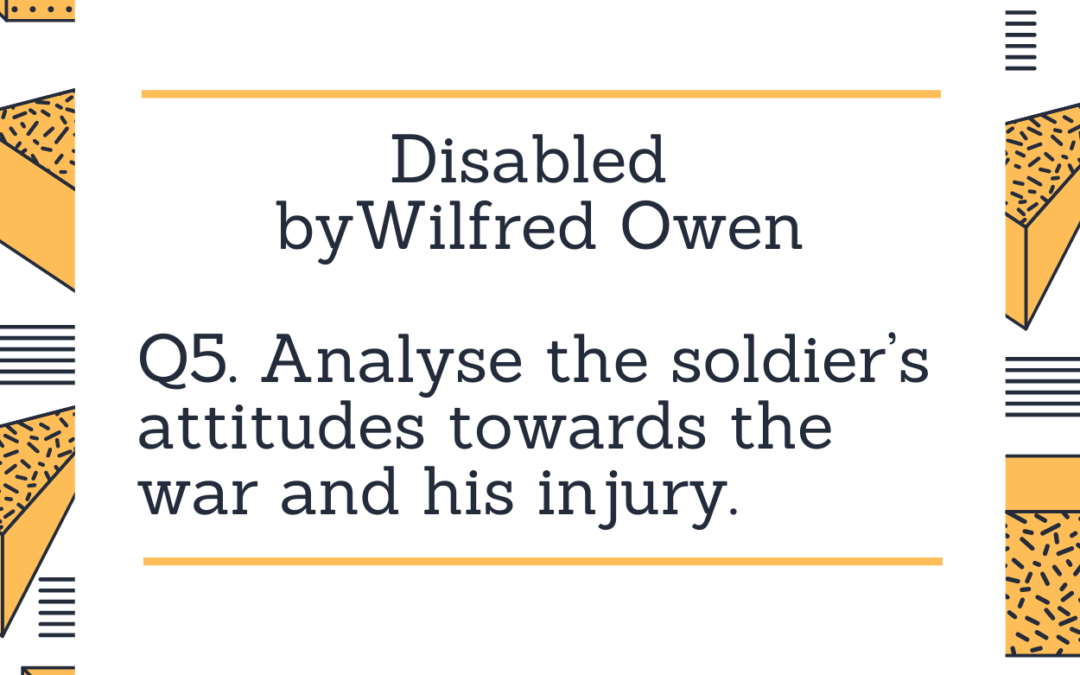
Q5. Analyse the soldier’s attitudes towards the war and his injury.

You should refer closely to the poem to support your answer. You may use brief quotations.


Edexcel English IGCSE Model Essay by an Expert

The soldier feels bitter towards the war and his injury, because of the resulting changes to his life. He also questions his reasons for joining the army.

This poem includes reflection on various parts of the soldier’s life which have changed for the worse since his injury. One poignant change is in his relationship with women. The sibilance and alliteration in his memories of women create a tone of sensual longing: “how slim girls’ waists are” and “how warm their subtle hands”. This gentle reflection contrasts with the bitter tone in the simile: they “touch him like some queer disease”, implying that women are now disgusted by him, and that he is only touched b nurses, who treat him like a medical subject. This is just one of several bitter reflections on how the war and his injury changed his life and future prospects.

The soldier also reflects resentfully on how he made such a life-changing decision. The short and alliterative sentence, “He wonders why,” shows his cynicism about his original reasons for joining the army. It is clear that the decision was not careful or considered: it was largely to please other people, including his girlfriend and someone who joked that he’d look good in the uniform. A more general sense of obligation is expressed in the line, “He thought he’d better join”. He also states that he “scarcely thought of” the reasons that the country went to war in the first place; he was not interested in Germany or Austria. The soldier feels that he did not come to an informed and independent decision about whether to join up, but was too easily influenced by the expectations of others.

A sense of anger is expressed when the soldier considers how unprepared he was for the experience of war. He had a romantic image of how war would be, as shown by the description of the superficial aspects of being in the army: “jewelled hilts”, “daggers in plaid socks” and “smart salutes”. This list creates a tone of disbelief that he could have been so deceived by the appearances of war. He admits that he was not ready for how frightened he would be: “no fears / Of Fear came yet”. Putting “Fear” with a capital letter shows how terrible and pervasive it is. This description movingly shows the many layers of fear experienced by a soldier; not only do you have to be afraid of death, but you are also afraid of dealing with this fear.

The soldier was unprepared for the war, and signed up for the wrong reasons. The result was a terrible injury which turned him from an optimistic youth to a bitter man, old before his time.

Students also browsed:

免費
【DSE英文】高中生常犯的英文寫作錯誤系列

【DSE英文】高中生常犯的英文寫作錯誤

免費
【HKDSE English writing sample 】 Paper 2 Writing Model Essays

【HKDSE English writing sample 】 Paper 2 Writing Model Essays

免費
Mixed tenses exercise in paragraph PDF

【Mixed tenses exercise in paragraph PDF 】Exercise 1-10

« » page 1 / 7


IGCSE Disabled by Wilfred Owen Model Essays Question 02

IGCSE Disabled by Wilfred Owen Model Essays Question 02

Edexcel English IGCSE: Disabled by Wilfred Owen

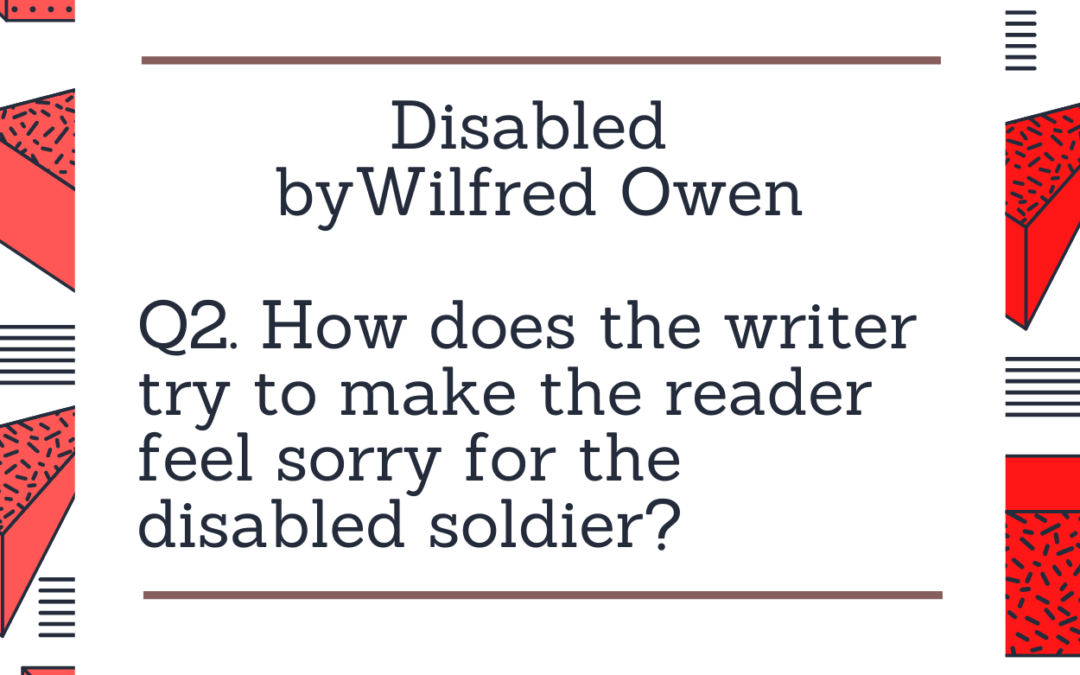
Q2. How does the writer try to make the reader feel sorry for the disabled soldier?

In your answer, consider:

  • the soldier’s life now compared to his past;
  • his experience of the war;
  • the use of language.

You should refer closely to the text to support your answer. You may use brief quotations.


Edexcel English IGCSE Model Essay by an Expert

The soldier in ‘Disabled’ evokes the reader’s pity because of the tragic contrasts between his life before and after the war. These contrasts were caused by a devastating injury during the war.

The soldier’s life before the war is described as happy and carefree, which makes his current situation all the more poignant. With beautiful imagery, Owen describes how the town used to appear to the soldier: “glow-lamps budded in the light-blue trees”. These soft, pleasurable colours contrast the “ghastly suit of grey” which he now wears; the alliteration in this description highlights his disgust. Owen also highlights the contrast in his appearance: just a year ago, he looked “younger than his youth”, but “now, he is old”. The repetition in the former phrase creates a sense of enthusiasm, which contrasts with the tired finality of the latter. By highlighting the difference in the soldier’s quality of life, Owen prompts the reader to pity the soldier.

The soldier’s experience of war provokes further sympathy. There is cruel irony in the fact that he was really too young to to join the army. The officials were “smiling” when they accepted him, which angers the reader, as they clearly didn’t care about the soldiers. There is also a graphic description of the soldier’s injury. The description “leap of purple spurted from his thigh” creates a vivid image of the injury, and encourages the reader to imagine the pain experienced by the soldier. Owen also shows that the injury drastically shortened the soldier’s life: “half his lifetime lapsed”. The alliteration in this phrase causes the reader to linger and reflect on the idea that the soldier’s life was wasting away. Through these images of pain and wasting youth, Owen encourages the reader to sympathise with the soldier.

The way that the soldier is treated makes the reader pity the soldier and also angry on his behalf. During the narration of the poem, the soldier is sitting outside in the cold. He wants to come inside, but is ignored, leading him to ask the repeated plaintive question, “Why don’t they come?”. This highlights his lack of independence, since he has to wait for assistance just to go indoors. However, it also reflects his loneliness and helplessness on a larger scale; since his injury, there has been no mention of the friends with whom he used to socialise, suggesting that he has been abandoned by all of society. This is shameful, considering that he sacrificed his health and youth out of a sense of duty to his country.

The soldier’s life and future has been changed for the worse, through a traumatic experience which he should never have endured. This tragic set of circumstances cause sympathy in the reader.


Students also browsed:

免費
【DSE英文】高中生常犯的英文寫作錯誤系列

【DSE英文】高中生常犯的英文寫作錯誤

免費
【HKDSE English writing sample 】 Paper 2 Writing Model Essays

【HKDSE English writing sample 】 Paper 2 Writing Model Essays

免費
Mixed tenses exercise in paragraph PDF

【Mixed tenses exercise in paragraph PDF 】Exercise 1-10

« » page 1 / 7


IGCSE Disabled by Wilfred Owen Model Essays Question 01

IGCSE Disabled by Wilfred Owen Model Essays Question 01

Edexcel English IGCSE: Disabled by Wilfred Owen

Q1. How does the writer try to bring out the thoughts and feelings of the disabled soldier in Disabled?

In your answer, you should write about:

  • the comparison between the soldier’s past and his present situation;
  • his experiences with women;
  • his reasons for becoming a soldier;
  • any other interesting use of language.

You should refer closely to the poem to support your answer. You may use brief quotations.


Edexcel English IGCSE Model Essay by an Expert

In ‘Disabled’, the soldier reflects bitterly the changes in his life since the war: namely changes to his body and in his experiences with women. The devastating impact of the war is made more sad by the flippant reasons that he had for going to war.

The soldier reflects the differences between his past and his current situation. One of the most striking changes is his physical appearance: he lost his limbs in the war. To describe the injury, Owen uses the unusual phrase: “he threw away his knees”. This creates the impression that the injury was the soldier’s fault, as though he had deliberately got rid of his legs. This reflects the soldier’s feeling that his injury was pointless and wasteful. Owen also highlights the contrast in the soldier’s self-perceived age; although only a year has passed, he looked “younger than his youth” before, and “now, he is old”. The simple expression of the latter state reflects the soldier’s sense of finality and hopelessness for the future.

The soldier’s experiences with women has also changed for the worse. He reflects on his previous experiences: “girls glanced lovelier” and “how slim / Girls’ waists are, or how warm their subtle hands”. The alliteration, and the repetition of ‘l’ and ‘s’ sounds in these descriptions reflect the sensual nature of his memories. However, “Now, he will never feel again”; again, this creates a sense of hopelessness. In his current situation, women “touch him like some queer disease”. This simile shows that the he believes that women find him disgusting and strange. The medicalization of his body in this image probably reflects the fact that he is only touched by nurses for medical reasons, no longer for pleasure.

After portraying the soldier’s thoughts and feelings about his current state, Owen reveals to the reader the superficial and flippant reasons that the soldier had for ‘joining up’. Rather than wanting to fight for his country and freedom, he “thought he’d better join”, suggesting a sense of obligation. The colloquial language in this line suggests that it was not a serious decision. When describing his feelings at joining the army, the soldier emphasises the romantic and attractive side of war, with a focus on superficial appearances: “jewelled hilts”, “daggers in plaid socks” and “smart salutes”. This naivety is all the more poignant now because we are now aware of the great losses that he has suffered as a result of his foolish decision.

When the soldier signed up to join the war, he could never have imagined the terrible implications of his decision. Through the soldier’s regretful and bitter thoughts and feelings, Owen portrays the loss of a generation’s youth, innocence and future.


Students also browsed:

免費
【DSE英文】高中生常犯的英文寫作錯誤系列

【DSE英文】高中生常犯的英文寫作錯誤

免費
【HKDSE English writing sample 】 Paper 2 Writing Model Essays

【HKDSE English writing sample 】 Paper 2 Writing Model Essays

免費
Mixed tenses exercise in paragraph PDF

【Mixed tenses exercise in paragraph PDF 】Exercise 1-10

« » page 1 / 7


IGCSE A Hero by R.K Narayan Model Essays Q2

IGCSE A Hero by R.K Narayan Model Essays Q2

Edexcel English IGCSE: A Hero by R.K Narayan

Q2. How successfully does the writer present the family relationships in ‘A Hero’?

You should write about the following:

  • Swami’s relationship with his father
  • the relationships between Swami, his grandmother and his mother
  • the relationship between Swami’s mother and father
  • the writer’s use of words, phrases and techniques.

You should refer closely to the text to support your answer. You may use brief quotations.


Edexcel English IGCSE Model Essay by an Expert

Swami’s father is authoritative, but ultimately subordinate to the women of the house. Swami’s relationships with his mother and grandmother are more positive.

Father and Swami have a tense relationship, because of Father’s unreasonable authoritarianism. Father is presented as cruel and harsh, for example he “sneered” at Swami’s opinions, and he repeatedly addresses Swami with imperatives, showing his control over him. He also cruelly compares Swami to a “baby” for sleeping with his Granny, and threatens to make him a “laughing-stock” at school. Swami is unable to defend himself, and has to resort to other techniques, such as changing the subject and hiding, to try to avoid Father’s wrath. Even after his experience in the office, Swami hides from Father, his ultimate emotion being “tremendously relieved” that Father is leaving him alone.

Swami has a better relationship with the female members of the household, particularly Granny. His relationship with Mother is initially quite cold, as she says that she “hardly know[s] anything about the boy”, and she does not try very hard to help him when he gives her a “look of appeal” on the way to the office. However, at the end of the story, she “lost her temper” with Father in Swami’s defence, showing that she has Swami’s best interests at heart. Swami’s relationship with Granny strongly contrasts his relationship with Father. Granny is described as a “good lady” who cares for Swami; this is in stark contrast to Father, who is subsequently described with the simile, “like an apparition”, making him seem like something evil and supernatural. Granny’s repeated questions when he goes to bed so early show concern for Swami, contrasting the challenging questions from Father earlier in the story.

Despite being dominating, Father clearly does not like directly contradicting the female members of the household. Mother uses imperatives to address him, mirroring his authoritative attitude towards Swami: “tell her so; and don’t look at me”. In this exchange, she is advising him to confront Granny about spoiling Swami; Father reacts to this by “gloomily gazing at his newspaper”, clearly showing that he does not wish to directly confront his mother. By then ignoring Granny’s pleading for him not to disturb Swami, Father avoids confrontation with her. At the end of the story, Swami is allowed to sleep back with his Granny, showing that Mother and Granny ultimately have more power than Father. Father’s loss of power is reflected in the ellipsis and use of qualifiers in his speech, showing his diminished confidence and authority.

Father is clearly a dominating character, which creates tension with Swami. However, it is eventually clear that it is the women of the house who have the final say in Swami’s upbringing.


Students also browsed:

免費
【DSE英文】高中生常犯的英文寫作錯誤系列

【DSE英文】高中生常犯的英文寫作錯誤

免費
【HKDSE English writing sample 】 Paper 2 Writing Model Essays

【HKDSE English writing sample 】 Paper 2 Writing Model Essays

免費
Mixed tenses exercise in paragraph PDF

【Mixed tenses exercise in paragraph PDF 】Exercise 1-10

« » page 1 / 7


IGCSE A Hero by R.K Narayan Model Essays Q3

IGCSE A Hero by R.K Narayan Model Essays Q3

Edexcel English IGCSE: A Hero by R.K Narayan

Q3. How does R.K. Narayan bring out the tensions in the relationship between Father and Swami and to what extent have these been resolved by the end of the story?

You should consider the following points:

  • their differing views on the newspaper article
  • their disagreement about where Swami should sleep
  • the impact of the incident with the burglar in the office
  • the writer’s use of language.

You should refer closely to the text to support your answer. You may use brief quotations.


Edexcel English IGCSE Model Essay by an Expert

In ‘A Hero’, Swami and his father have a tense relationship, as Father is often harsh towards Swami. Although the conflict about where Swami sleeps seems to be resolved at the end of the story, the writer implies that this peace might be temporary.

The story opens with disagreement over a newspaper article, prompting the increasing tension between Swami and Father. Father addresses Swami with an imperative – “Swami, listen” – which highlights the instructive and demanding nature of their relationship. Language of disagreement and conflict highlights the tension between them: Father “sneered” at Swami and Swami “disputed” Father’s theory about courage. When he makes the valid point that courage would be pointless if he were attacked by a tiger, Father shifts the argument to question Swami’s courage, rather than arguing reasonably with his son. This defensive style of argument implies great tension in their relationship.

The relationship between Father and Swami continues to worsen, as the subject of their dispute changes to where Swami sleeps at night. Swami “tried to change the subject”, implying that he is unwilling to argue with his father directly, perhaps because he knows he will lose. Swami also knows “his father’s tenacity at such moments”. These facts imply that Swami knows his father well, meaning that this tension probably exists in their relationship all the time. Nevertheless, Swami attempts to compromise with his Father, but this is met with derision: Father replies with a definite “No” and cruelly compares Swami to a “baby”. This reveals an ultimate tension in their relationship, since Father is not even prepared to compromise.

Although Swami is allowed to sleep back with his Granny after the burglar incident, the tension with his father isn’t resolved. It is not clear whether Father praised Swami; the passive voice in “congratulations were showered” is ambiguous about who praised him. He is also still angry about the sleeping arrangements, which suggests that the incident didn’t impact their relationship much. It implies that Father cannot accept that Swami was courageous, even though Swami passed his test of sleeping in another room, and even attacked an intruder. Father also refers to Swami as “the boy”, implying a lack of respect. The only change is that he decides not to pursue the issue this time, but this could be due to Mother’s influence. The story ends with Swami being “tremendously relieved” that Father was “giving him up” – this suggests a mere break in open conflict, rather than a resolution of tension in their relationship.

In conclusion, the relationship between Father and Swami is clearly tense, and this is only partially resolved at the end of the story, in spite of the dramatic events of Swami’s night in the office.


Students also browsed:

免費
【DSE英文】高中生常犯的英文寫作錯誤系列

【DSE英文】高中生常犯的英文寫作錯誤

免費
【HKDSE English writing sample 】 Paper 2 Writing Model Essays

【HKDSE English writing sample 】 Paper 2 Writing Model Essays

免費
Mixed tenses exercise in paragraph PDF

【Mixed tenses exercise in paragraph PDF 】Exercise 1-10

« » page 1 / 7


IGCSE A Hero by R.K Narayan Model Essays Q4

IGCSE A Hero by R.K Narayan Model Essays Q4

Edexcel English IGCSE: A Hero by R.K Narayan

Q4. How does R. K. Narayan try to show Swami’s thoughts and feelings throughout ‘A Hero’?

In your answer, you should write about:

  • Swami’s relationship with the members of his family
  • Swami’s experience during the night in the office
  • the use of language.

You should refer closely to the text to support your answer. You may use brief quotations.


Edexcel English IGCSE Model Essay by an Expert

Swami has a tense relationship with his father, and is terrified while in the office. He is humorously underwhelmed by the experience at the end of the story.

Swami’s desperate attempts to avoid his father’s idea of sleeping in the office reveal both his fear of sleeping away from his granny and his relationships with members of his family. His relationship with his father is difficult, as shown through his underhand attempts to avoid having to carry out his plan of sleeping in the office. For example, he tries to change the subject “very loudly and with a great deal of enthusiasm”. The qualified adverbial phrases show his desperation. Another tactic is to sneak away and pretend to be asleep. The repetition in his speech to his granny – “Please, please, shut up, granny” – again reveals his desperation, and also shows his good relationship with his granny, with whom he feels able to use imperatives. This contrasts his deferential attitude towards his father.

The night in the office is so terrifying for Swami that he thinks that he will die. The writer uses a number of techniques to capture the extent of Swami’s fear. For example, the description of the experience appeals to the reader’s senses. The “ray of light” which “cast shadows” appeals to the reader’s sight, reminding them of how frightening it is to watch shadows on a wall as a child. Onomatopoeia is used to appeal to the sense of sound, reflecting Swami’s heightened senses due to his fear: for example, rustle”, “snoring” and “humming”. The use of hyperbole also shows the exaggerated nature of Swami’s fear. For example, the simile “used his teeth on it like a mortal weapon” shows that Swami believed his life to be in danger.

Following the experience, Swami does not seem interested in his new status as the titular “Hero”. When it is revealed that Swami has accidentally caught a notorious burglar, it is said that “congratulations were showered” on him. The use of the passive voice suggests that he is a passive receiver of the praise. There is no mention of Swami feeling proud or excited about his experience, and he reacts with “politeness” to the police, rather than excitement. This implies that Swami is not very interested in being a hero. At the end of the story, he is “under the blanket” again, creating a childish image, and showing his continuing fear of the office. His overwhelming feeling is “tremendously relieved” that he is able to sleep with his granny, showing that this is the most important thing to him.

In this story, Swami accidentally becomes a ‘hero’ by catching a burglar. However, his main priority is to be able to sleep where he feels safe.


Students also browsed:

免費
【DSE英文】高中生常犯的英文寫作錯誤系列

【DSE英文】高中生常犯的英文寫作錯誤

免費
【HKDSE English writing sample 】 Paper 2 Writing Model Essays

【HKDSE English writing sample 】 Paper 2 Writing Model Essays

免費
Mixed tenses exercise in paragraph PDF

【Mixed tenses exercise in paragraph PDF 】Exercise 1-10

« » page 1 / 7


Pin It on Pinterest